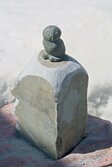
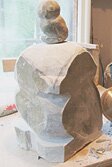
The Sculpting Process
Planning, model making, abstract thinking and feeling begin the process, but the stage in the middle, the carving/sculpting are what most of us view as the process...
The basic method of carving stone has not changed dramatically over the years. Refinement in the hardening process has improved chisels and the advent of air driven chisel hammers aids the process, but most carvers still employ wooden mallets and metal hammers for fine detail work.
One recent addition many carvers employ is the diamond saw. Diamond tipped blades were first used to cut large blocks into slabs, replacing the ancient method of water and quartzite sand slurry as an abrasive for iron or steel blades. Diamond blades are manufactured in small dimensions and attached to hand held grinders; they can quickly remove material to rough out a block into the basic shape desired. Generally the artist will switch to a chisel and air powered hammer or use a hand hammer or wood mallet and chisel to finish roughing out. Starting with a point chisel, the carver will proceed to a claw or tooth shaped chisel, then on to a flat chisel.
Once the artist is satisfied with the nearly finished shape, files, rasps and rifflers are employed to obtain final details if a sanded or polished surface is desired. Just as it is true of chisels, rifflers come in a bewildering array of sizes and shapes but the basic slightly “S” curved tool is the one most often employed to remove the tool marks left from the chisel or saw and bring the work to its final form.
The next step is proceeding from course to very fine sanding. The old methods have given way to wet/dry sand paper and diamond sanding hand pads. This process is slow and exacting, but as simple as being sure you remove the marks left by the previous stage.
This carver would like to add that although nothing compares to the joy of finishing a piece and certainly the polishing process has great reward, this sanding stage can hold some of the greatest magic for the carver in that it can induce a true meditative state when time can be completely lost and wonderful insight and peace often come.
Generally carvers achieve a 600-800 grit finish prior to polishing. Dependent on the type of stone and the degree of polish needed, agents such as Oxalic acid crystals, Aluminum oxide, or Tin oxide in powder can be employed. Dry agents mixed with water to form a paste reapplied by hand rubbing with a felt pad. Another method is to apply commercially available wax with Aluminum Oxide in a stick utilizing a power buffing wheel.